
- Home
- About Us
- Services
- Audit & Assurance
- Corporate Tax
- Value Added Tax
- Transfer Pricing
- Transfer Pricing Defense Services in UAE
- Transfer Pricing Benchmarking Services in UAE
- Transfer Pricing Due Diligence Services in UAE
- Transfer Pricing Compliance and Documentation Services in UAE
- Transfer Pricing Structure Design Services in UAE
- Transfer Pricing Policy Drafting and Review Services in UAE
- Business Setup
- Accounting
- AML
- Payroll
- Other Services
- Blog
- Careers
- Contact
What Are E-Invoicing Services and How Can Businesses in Dubai, UAE Prepare for E-Invoicing?
German FinTax
October 19, 2026
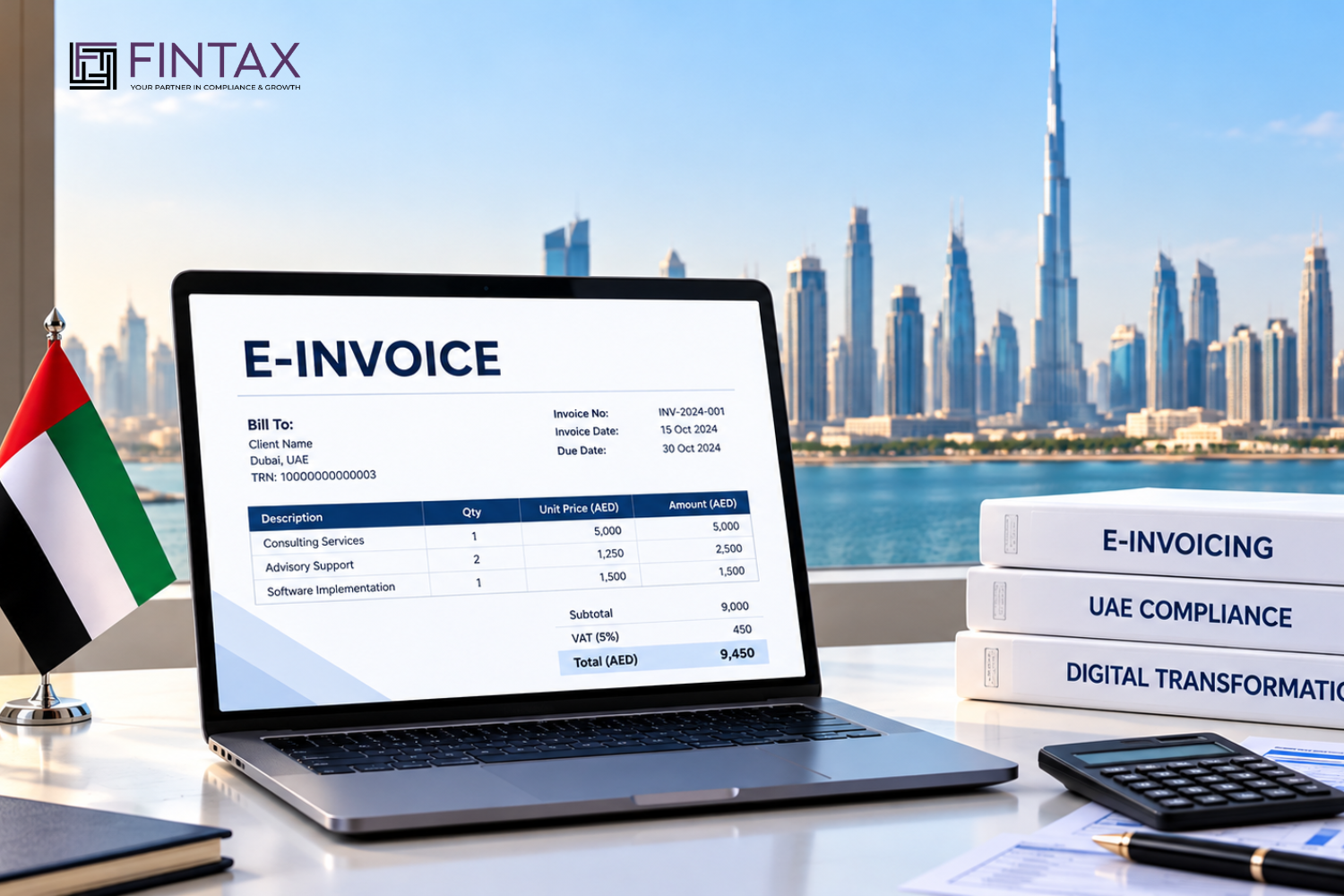
The UAE is introducing a national electronic invoicing system that will change how businesses issue, exchange and report invoices. For companies in Dubai, UAE, preparing for this transition involves reviewing accounting software, VAT records, customer information and invoice-processing procedures.
Professional e-invoicing services in Dubai, UAE help businesses assess their readiness, organise financial data, coordinate technology integration and prepare for regulatory compliance.
With mandatory implementation beginning in January 2027, businesses should start preparing according to their applicable deadlines.
What Is E-Invoicing Under UAE Regulations?
E-invoicing involves creating, exchanging and reporting invoices electronically in a structured, machine-readable format.
Unlike traditional invoicing, the UAE framework enables automated invoice exchange through Accredited Service Providers (ASPs).
A PDF invoice sent by email is not a compliant structured e-invoice. Scanned documents, images and ordinary Word files also do not satisfy the prescribed format.
The system aims to improve invoice accuracy, processing efficiency and tax reporting.
The UAE Ministry of Finance eInvoicing Portal provides official legislation, technical guidance and implementation information.
When Does E-Invoicing Become Mandatory in Dubai, UAE?
Ministerial Decision No. 244 of 2025, as amended in 2026, establishes a phased implementation schedule.
| Business Category | ASP Appointment Deadline | Mandatory Implementation |
|---|---|---|
| Annual revenue of AED 50 million or more | 30 October 2026 | 1 January 2027 |
| Annual revenue below AED 50 million | 31 March 2027 | 1 July 2027 |
| In-scope government entities | 31 March 2027 | 1 October 2027 |
The pilot programme began on 1 July 2026.
Businesses with annual revenue of AED 50 million or more should prioritise ASP selection because their revised appointment deadline is approaching.
Which Businesses Must Implement E-Invoicing?
The initial mandatory framework generally covers in-scope business-to-business (B2B) and business-to-government (B2G) transactions.
It may affect Mainland companies, Free Zone businesses, manufacturers, traders, professional service providers and corporate groups.
Business-to-consumer (B2C) transactions are excluded from the initial mandatory scope until otherwise determined.
Businesses should assess their transaction types and applicable exclusions rather than relying solely on VAT registration status.
How Does the UAE Five-Corner E-Invoicing Model Work?
The UAE uses a Peppol-based five-corner framework:
- Supplier
- Supplier’s Accredited Service Provider
- Buyer’s Accredited Service Provider
- Buyer
- Federal Tax Authority
The supplier generates structured invoice data through its accounting system. Its ASP validates and exchanges the invoice with the buyer’s ASP, while the required information is reported to the Federal Tax Authority.
Businesses remain responsible for accurate invoice information, appropriate tax treatment and accounting records.
What Are E-Invoicing Services in Dubai, UAE?
Professional e-invoicing implementation support generally includes:
E-Invoicing Readiness Assessment
Reviewing existing accounting systems, transaction types, invoicing processes and implementation deadlines.
Accounting Data Preparation
Checking customer records, supplier details, VAT classifications, invoice numbers and credit note information.
ASP Selection and Integration Support
Assisting businesses in comparing accredited providers and coordinating software integration.
Invoice Workflow Configuration
Establishing procedures for invoice creation, validation, transmission, rejection handling and approval.
Testing and Reconciliation
Comparing structured invoices against accounting ledgers, VAT records and transaction documents.
Employee Training
Preparing finance teams to operate new invoicing processes and resolve transmission errors.
How Should Businesses Prepare Their Accounting Records?
Accurate financial data is essential for successful implementation.
Businesses should review customer legal names, supplier information, Tax Registration Numbers where applicable, invoice dates, product descriptions, taxable amounts, VAT rates and credit notes.
For example, incorrect customer identifiers or incomplete invoice fields may lead to processing failures.
Professional Accounting and Bookkeeping Services in Dubai, UAE can help businesses reconcile transactions and improve record accuracy.
How Does E-Invoicing Affect VAT Calculations?
E-invoicing does not change the underlying VAT rate or eliminate existing VAT obligations.
Consider a standard-rated domestic transaction:
| Invoice Component | Amount |
|---|---|
| Taxable value | AED 20,000 |
| VAT at 5% | AED 1,000 |
| Invoice total | AED 21,000 |
The structured invoice must correctly reflect the transaction and applicable tax treatment.
If the taxable value is subsequently reduced by AED 2,000, an appropriate credit note may be required, with a corresponding AED 100 VAT adjustment where the relevant conditions are satisfied.
Businesses should reconcile invoices, credit notes, VAT returns and accounting records.
Professional VAT Registration Services in Dubai, UAE can assist with related registration requirements.
What Is an Accredited Service Provider?
An Accredited Service Provider is an authorised technology provider that facilitates electronic invoice exchange under the UAE framework.
Businesses should evaluate ASPs based on accreditation status, software compatibility, integration capabilities, security, technical support, service fees and error-handling procedures.
Selecting an ASP is different from appointing an accounting or tax consultant. Businesses should verify provider accreditation through official government information.
How Can Businesses Implement E-Invoicing Step by Step?
A practical implementation plan includes:
Step 1 — Confirm applicability: Identify relevant business transactions and implementation deadlines.
Step 2 — Review existing systems: Assess whether accounting or ERP software supports the required structured invoicing format.
Step 3 — Clean financial data: Correct customer records, supplier details and VAT classifications.
Step 4 — Select an ASP: Verify accreditation, obtain quotations and confirm technical compatibility.
Step 5 — Complete onboarding: Contract with the ASP, integrate systems and complete the applicable EmaraTax procedures.
Step 6 — Test transactions: Check invoice generation, transmission, receipt and credit note processing.
Step 7 — Train employees: Establish procedures for approvals, exceptions and rejected invoices.
Step 8 — Monitor compliance: Review transmission reports, reconciliations and system performance after implementation.
What Internal Controls Are Important for E-Invoicing?
Businesses should establish controls over invoice numbering, customer master data, VAT treatment, access permissions, approvals, credit notes and electronic records.
For example, a rejected invoice should trigger an investigation and correction procedure rather than remaining unresolved.
Management should also assign responsibility for monitoring failed transmissions and reconciling invoice information with the general ledger.
Does E-Invoicing Replace VAT Returns?
No. Businesses must continue meeting applicable VAT registration, return filing, payment and recordkeeping obligations.
E-invoicing improves the electronic exchange and reporting of invoice information but does not replace all tax compliance activities.
The Federal Tax Authority’s UAE E-Invoicing Guidance provides additional information about the framework.
How Does E-Invoicing Support Corporate Tax Compliance?
Accurate electronic invoice records can support revenue reporting, expense documentation and financial statement preparation.
However, electronic invoice acceptance does not automatically make an expense deductible for Corporate Tax purposes.
Businesses should continue evaluating expenses, Related Party transactions and accounting adjustments under the applicable rules.
Professional Corporate Tax Consultancy Services in Dubai, UAE can assist with related tax compliance requirements.
What Are Common E-Invoicing Implementation Mistakes?
Businesses should avoid assuming PDFs are compliant e-invoices, delaying ASP selection, maintaining incomplete customer records, applying incorrect VAT codes or overlooking credit note testing.
Other risks include inadequate employee training, unresolved transmission errors and failing to assess Free Zone transactions.
Early preparation reduces implementation delays and operational disruption.
German Fintax Consultancy – E-Invoicing Support in Dubai, UAE
German Fintax Consultancy provides accounting, taxation and financial compliance support for businesses in Dubai, UAE.
Our e-invoicing readiness services can help businesses review accounting records, identify invoice data inconsistencies, improve VAT reconciliation and coordinate implementation requirements within the agreed advisory scope.
Our financial reporting and compliance experience supports businesses preparing for the UAE’s digital invoicing transition.
Learn more About German Fintax Consultancy and our professional services.
Looking for E-Invoicing Services in Dubai, UAE?
Preparing for UAE e-invoicing requires accurate financial records, compatible software, an appropriate Accredited Service Provider and reliable internal controls. German Fintax Consultancy can help your business assess its readiness and prepare the accounting and compliance processes required for implementation in Dubai, UAE.
Contact us today to discuss your requirements.
CALL NOWFrequently Asked Questions
What are e-invoicing services in Dubai, UAE?
They include readiness assessments, accounting data preparation, ASP coordination, invoice workflow reviews and compliance support.
When does mandatory e-invoicing begin in Dubai, UAE?
The first mandatory implementation phase begins on 1 January 2027.
What is the ASP deadline for larger businesses in Dubai, UAE?
In-scope businesses with annual revenue of AED 50 million or more must appoint an ASP by 30 October 2026.
Are PDF invoices accepted as compliant e-invoices in Dubai, UAE?
No. The framework requires structured electronic invoice information.
Do Dubai Free Zone companies need e-invoicing in Dubai, UAE?
Free Zone companies may fall within the framework depending on their transactions and applicable exclusions.
Does e-invoicing apply to B2C transactions in Dubai, UAE?
B2C transactions are excluded from the initial mandatory scope until otherwise determined.
What is an Accredited Service Provider for businesses in Dubai, UAE?
An ASP is an authorised technology provider supporting electronic invoice exchange under the UAE framework.
Does e-invoicing replace VAT returns in Dubai, UAE?
No. Existing VAT filing and payment obligations continue to apply.
What software is needed for e-invoicing in Dubai, UAE?
Businesses need accounting or ERP systems capable of working with the required structured invoicing process, directly or through suitable integration.
How can German Fintax Consultancy help businesses prepare for e-invoicing in Dubai, UAE?
German Fintax Consultancy can assist with accounting readiness, VAT reconciliation, financial data reviews and implementation coordination.